


Live Singers vs Recorded Music for Your Event
A perfectly curated playlist can fill a room, butlive voices can change it. When weighing live singers vs recorded music, the right choice comes down to more than sound quality or budget. It affects how guests arrive, mingle, react, and remember the occasion.
For corporate functions, weddings, tourism programs and private celebrations, music is often the element that sets the emotional temperature before a host says a word. Recorded music is practical and familiar, but live vocal entertainment is personal, responsive, and impossible to replicate in exactly the same way twice.
Recorded music has a clear place
Recorded music is a sensible option for many event moments. It offers a huge catalogue, works well for background atmosphere and can run for hours with very little active management. For a casual reception, a trade show floor with competing conversations or a late-night dance set, a playlist or DJ may be exactly what the event needs.
It also gives organisers precise control. A marketing team can approve every song in advance. A wedding couple can build a playlist full of personal favourites. Volume can be kept low and consistent during dinner, while upbeat tracks can be introduced later to shift the energy.
However, that convenience has limits. Recorded music cannot read the room, acknowledge a milestone, change pace when guests are distracted, or draw an audience into a shared moment. Even an excellent playlist remains part of the background unless the event has a dedicated DJ, lighting and dance-focused format to make it the main attraction.
What live singers bring that a playlist cannot
Live singers create a visible focal point. Guests do not merely hear the music while collecting a drink or finding their table. They see skilled performers making it in front of them, responding to the setting and inviting attention without demanding it.
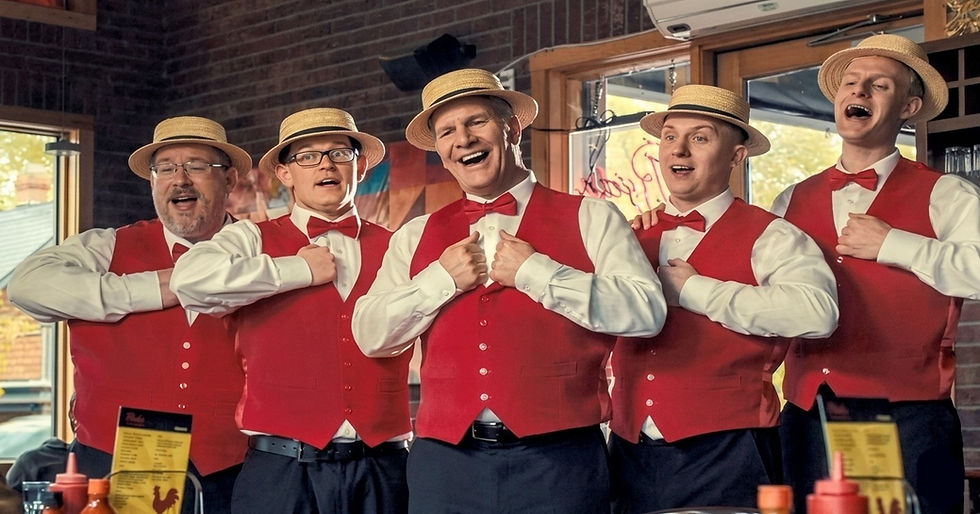
With a cappella performances, that effect is especially immediate. Four voices create harmony, rhythm and character without a stage full of instruments, amplifiers or equipment. The format can feel refined at a formal dinner, playful at a promotion and warmly nostalgic at a family celebration.
A strong vocal group also has the freedom to shape each appearance around the crowd. A jazz standard may suit a cocktail reception. Doo wop can bring a burst of fun to a staff celebration. Country arrangements may feel right at a Western Canadian event, while Christmas music can give seasonal programs instant character. The performance is not simply played at the guests... it happens with them in the room.
This is where experience matters. Professional singers know when to perform, when to circulate, when to lower the intensity and when to land a showpiece song. They can maintain polish while adapting to a delayed program, a surprise presentation, or a room that needs a lift.
Live singers vs recorded music at corporate events
Corporate events often need more than pleasant background sound. They need a professional atmosphere that supports a business objective: welcoming clients, thanking employees, opening a conference, creating a photo-worthy activation or helping sponsors stand out.
Recorded music can support these goals, but live singers can make the entertainment part of the event's identity. An a cappella quartet is visually distinctive, compact and easy for guests to approach. It can perform a short, high-impact set for a keynote entrance, provide polished music during networking, or move through a reception space to create natural conversation starters.
For branded events, a live group can also give a familiar song new relevance through a tailored introduction, a timely lyric reference where appropriate, or repertoire that fits the theme. That makes the entertainment feel selected for the occasion rather than added as an afterthought.
But there is a practical advantage too. A vocal quartet generally requires less physical space and technical infrastructure than a full band. This can be valuable in hotel ballrooms, office receptions, retail settings, visitor centres and venues where the production schedule is tight. Less equipment does not mean less impact. In the right setting, close harmony can command attention more effectively than louder music.
The wedding question: atmosphere or soundtrack?
For weddings, recorded music and live performance often work best together rather than as competing choices. A carefully chosen recording may be ideal for the first dance, while live singers can add warmth to guest arrival, cocktails, photographs or the transition between ceremony and reception.
The advantage of live vocals is their ability to make a couple's chosen music feel genuinely theirs. A song performed in close harmony has texture, movement and a sense of occasion that guests notice. It creates those small pauses in the day when relatives stop talking, turn towards the music and share the moment.
That said, couples should consider the mood they want. If the priority is a packed dance floor until midnight, recorded music with a skilled DJ is usually the stronger foundation. If the aim is elegant, memorable entertainment during the social parts of the day, live singers are an excellent fit. Many successful wedding plans make room for both.
Reliability, logistics and the real cost of each choice
A playlist appears less expensive because it may use equipment already available at the venue. Yet the comparison is not only about the initial fee. It is about what the entertainment is expected to do.
If music only needs to avoid silence, recorded tracks are efficient. If it needs to welcome guests, reinforce a premium brand, entertain mixed ages, and create a moment people discuss afterwards, the value calculation changes.
Professional live performers should be booked with the same care as any key supplier. Ask about repertoire, set length, arrival time, performance area, power requirements, microphones and contingency plans. For a cappella groups, the technical needs may be lighter, but the details still matter. Clear scheduling ensures performers are ready for the moments that matter most.
It is also wise to think about guest demographics. A mixed audience may respond especially well to close-harmony arrangements because the repertoire can span generations without becoming generic. Familiar standards, doo wop, country favourites, jazz and seasonal songs give organisers options that feel broad without trying to please everyone with one track list.
When a cappella is the stronger choice
A cappella is particularly effective when organisers want music that feels polished but not overproduced. It works beautifully in spaces where a full band would be too loud or too large, and in events where guests need to continue talking while still enjoying a performance.
It can also be more memorable than background music because the human voice is naturally direct. There is no instrument between the performer and the audience. Harmony, expression and personality are the product. For promotions, tourism attractions and media appearances, that clarity translates well: guests can see what is happening immediately, and the act creates a natural visual as well as an audible feature.
Executive Quartets has delivered more than 250 performances across Western Canada over more than 20 years, demonstrating why dependable, adaptable vocal entertainment remains a strong choice for organisers who need more than a playlist.
Choose the music format around the event moment
The best decision is rarely all live or all recorded. Consider the role music must play at each point in the programme. Recorded music may handle long stretches of background sound and dancing. Live singers may be reserved for arrivals, a featured set, an awards presentation, a festive reveal or a key transition when the room needs attention.
Start with the feeling guests should take away. Do you want a relaxed soundtrack, a high-energy party, a sophisticated welcome or a performance they will film and share? Then match the format to that purpose, the venue and the audience.
When the occasion calls for genuine connection, choose music that can look guests in the eye, react to their applause and make the room feel briefly, unmistakably alive.


Comments