

What Makes Barbershop Music Unique?
A barbershop quartet can turn a familiar song into a moment guests remember long after the final chord. So, what makes barbershop music unique? It is the thrilling combination of four unaccompanied voices, close harmony, precise tuning and a sound that seems bigger than the number of performers on stage.
For an event audience, that distinction matters. A polished quartet brings the energy of live music without needing a bandstand full of equipment, while its rich sound can suit a formal dinner, a wedding reception, a seasonal gathering or a lively promotional appearance. The music feels both immediate and remarkably refined.
But What Makes Barbershop Music Different?
At its core, barbershop is four-part a cappella harmony. There are no instruments to cover a missed entrance, support the pitch or create atmosphere. Every rhythmic accent, every chord and every emotional shift comes directly from the singers.
The four parts have distinct roles. The lead usually carries the melody, while the tenor sings above it, often in a bright, high line. The bass anchors the harmony with low notes, and the baritone supplies the essential notes that complete the chord. Together, they create a tightly blended texture rather than four separate vocal lines competing for attention.
This is not simply four people singing in harmony. Classic barbershop arrangements are built to place chords front and centre. The parts often move together rhythmically, allowing listeners to hear the harmony change clearly from one word to the next. That directness gives barbershop its unmistakable impact, whether the quartet is performing a vintage standard, a doo wop favourite, a country number or a well-chosen modern arrangement.
The ringing chord
The signature barbershop sound is the ringing chord. When four singers tune a chord with exceptional accuracy, their voices produce extra audible tones called overtones. Listeners may not know the technical term, but they recognise the effect: the chord suddenly seems to expand, shimmer or ring above the singers themselves.
This is why barbershop performers pay such close attention to vowel shape, breath, balance and tuning. A chord is not merely correct or incorrect. It can be ordinary, well blended or genuinely electrifying. The best quartets adjust in real time, listening closely to one another and making tiny changes that help the whole sound lock into place.
That level of precision gives a live performance an edge that recorded music cannot quite replicate. Guests hear the chord form in the room, then feel its resonance in real time. It is a small musical miracle, delivered without amplification when the setting allows.
Close harmony with a clear emotional message
Barbershop is highly musical, but it is not music for musicians alone. Its arrangements are designed to communicate a lyric clearly. A great performance makes the words understandable, gives the story shape and uses harmony to heighten the feeling behind each phrase.
A tender ballad can feel warm and personal because the voices literally surround the melody. A comic song can become even funnier through a perfectly timed pause, an exaggerated chord change or a shared reaction between quartet members. Up-tempo material gains momentum from crisp consonants and coordinated movement.
The music’s accessibility is part of its strength at events. Guests do not need specialist knowledge to enjoy it. They simply respond to the familiar melodies, the vocal colour and the pleasure of hearing four people create a complete musical world together.
The visual performance is part of the sound
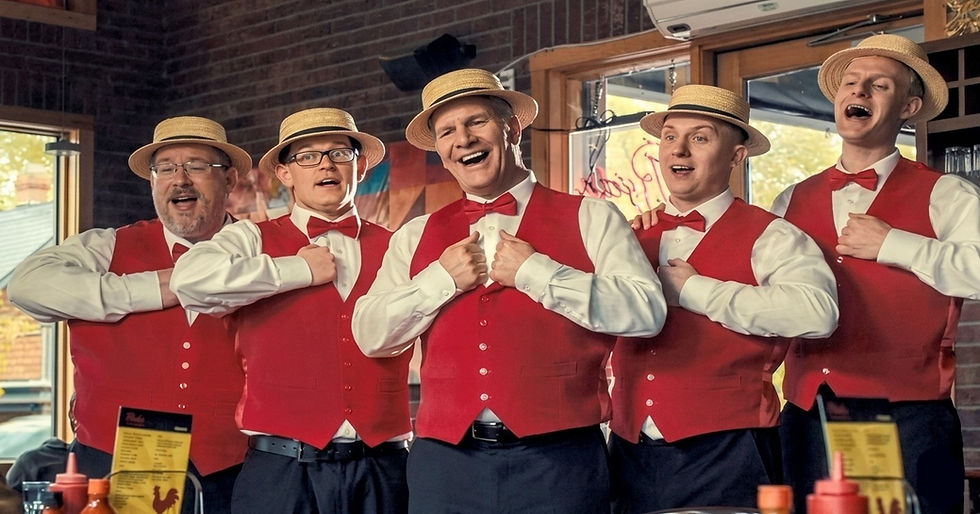
Barbershop is often associated with old-fashioned costume, straw hats and nostalgic repertoire. Those traditions have a place, particularly when a client wants a heritage or period feel. But the defining feature is not the costume. It is the performance craft.
A professional quartet uses eye contact, facial expression, staging and timing to make the music land. Because the singers are not standing behind instruments, they can engage guests directly. They can welcome people at an entrance, move through a reception space, present a short feature set or hold attention on a main stage.
That flexibility makes the format especially effective for corporate functions and private celebrations. The act can feel polished without becoming distant, and entertaining without overwhelming the occasion. The best presentation depends on the room, guest numbers and programme. A formal awards evening may call for a focused stage set, while a garden reception may suit lighter, more mobile entertainment.
Why the four-voice format works so well at events
There is a practical advantage to barbershop’s distinctive sound. A quartet can create a full musical experience with a compact footprint. With no drum kit, guitar amplifiers or extensive backline, setup is often simpler than for a conventional band. That can be valuable in venues with limited space, tight schedules or multiple programme changes.
The trade-off is that a cappella performance depends on the right conditions. A large, noisy room may require professional sound reinforcement, particularly if the quartet is performing during dinner service or for a sizeable crowd. The group must also choose repertoire that matches the event rather than treating every booking as a concert hall appearance.
This is where experienced performers make a clear difference. They read the room, adjust volume and pacing, and select songs that support the purpose of the gathering. A short, high-impact performance may be ideal for a product launch. A wedding might benefit from a romantic feature song and upbeat reception music. A Christmas event can invite audience participation without losing a premium feel.
It is tradition, but not a museum piece
Barbershop developed from popular vocal traditions, and its classic repertoire remains part of the appeal. Songs from the early twentieth century, jazz standards and sentimental melodies give the style its warmth and recognisable character. Yet barbershop is more adaptable than many people expect.
A skilful quartet can bring its harmony approach to doo wop, country, festive music and selected contemporary songs. Not every song translates equally well. Music with a strong beat-driven identity, highly fragmented melody or dense electronic production may lose something when reduced to four voices. But songs with clear melodic lines and expressive harmony can become especially compelling in a barbershop arrangement.
The key is not forcing every popular song into the style. It is choosing music that lets the arrangement breathe, gives each voice a meaningful role and provides space for those memorable ringing chords.
The human element guests notice
Live barbershop has an honesty that is difficult to manufacture. The performers must breathe together, start together, listen constantly and recover gracefully if anything unexpected happens. That shared concentration is visible, and audiences respond to it.
It also creates a natural connection across generations. Older guests may recognise a classic song immediately. Younger listeners may be drawn in by the vocal skill, humour and novelty of hearing an entire arrangement made with human voices. When the repertoire is planned well, the quartet becomes a conversation starter as well as entertainment.
For more than 20 years, Executive Quartets has seen how effectively this format works in real event settings across Western Canada. The right four voices can provide sophistication, nostalgia, humour and genuine musical excitement in one compact performance.
When planning entertainment, look beyond the question of whether guests will know every song. Choose performers who can create a response in the room. A beautifully tuned barbershop chord does exactly that: it stops conversations, raises smiles and leaves an occasion with a sound all its own.
Comments